 Familias
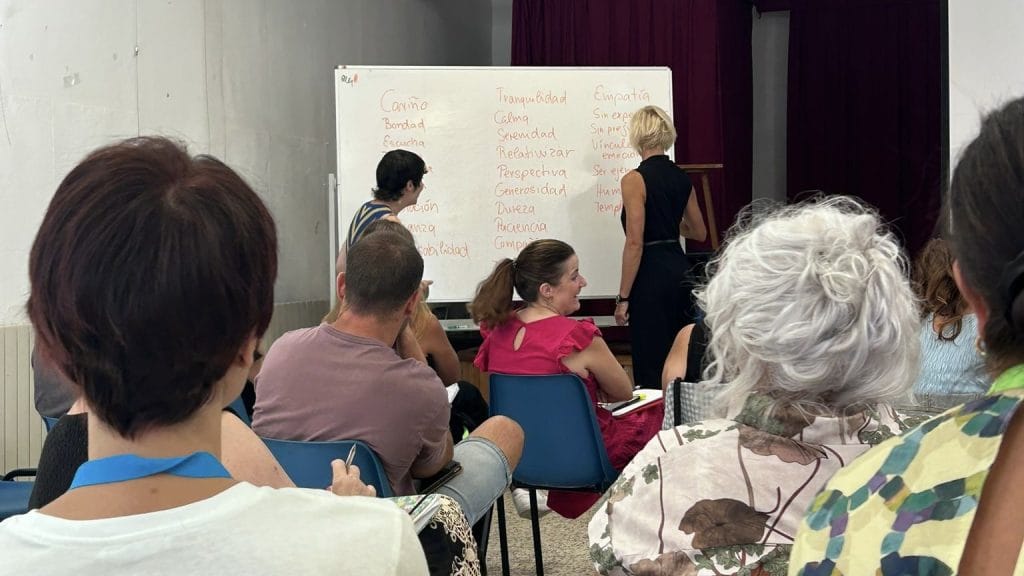
Last Thursday and Friday, I had the opportunity to deliver a teacher training programme in inclusive education and diversity with the teaching team at IES Bernardino de Escalante in Laredo.
“I’m delighted. I’m leaving with the feeling that, yes, I can do something.”
These were some of the words I heard at the end of the training, and they stayed with me. It was a joy to finish the two days with the sense that the participants felt empowered and able to create change from their own position and in their everyday work in the classroom.
Looking beyond behaviour
Rather than looking for formulas or specific answers to particular situations, the training started from a different place: taking a moment to look at how we look.
From a systemic perspective, we also considered the resources around us that can help us respond to the different needs of our students.
Through different activities and moments of self-reflection, we explored our own attitudes, values and the ideas we bring into the classroom. We discussed how each person learns differently and how these differences do not depend on whether someone has a diagnosis.

We also considered how the same situation can take on very different meanings depending on the perspective from which we observe it.
One question ran through much of the training. It was simple, but not always easy:
What lies behind what we are seeing?
An interruption, a student who does not participate, someone who seems disconnected, moves constantly or does not follow an instruction are all observable behaviours. But behaviour alone does not explain what is happening.
Changing the question from “What is wrong with them?” to “Why might this be happening?” opens up other possibilities. It allows us to consider needs, context, emotions, difficulties, different ways of processing information and situations that we may not yet be seeing.
Relationships are part of learning
To learn, we need to feel safe, calm, respected and confident, at least to some extent.
The relationship we build with a student does not exist separately from learning. It forms part of the context in which learning can take place.
That is why I particularly like this quote:
“When a flower doesn’t bloom, you fix the environment in which it grows, not the flower.”
— Alexander Den Heijer

This does not mean that the environment explains everything. It means that when something is not working, it is also worth asking what we can change, what we can adapt and what the situation is telling us.
Supporting diversity is a team effort
Another important part of these two days was the value of the team.
Teachers already have a wealth of experience, ideas and resources. Sometimes, it is not so much about introducing something completely new, but about putting existing resources into motion, sharing them, discussing them and building new ways of responding in the classroom together.
Supporting diversity is not an individual task.
We need to talk to each other, ask questions and share both what works and what does not. We also need to listen to the student, consider different perspectives and allow ourselves to change our position when another way of looking at a situation helps us understand it better.
Two days to reflect and open up new questions
This experience of teacher training in inclusive education allowed us to share ideas and reflect on diversity, educational needs, relationships and the classroom environment.
It was a pleasure to work with such engaged, thoughtful, dynamic and motivated people, and to share a space where we not only looked for answers, but also opened up new questions.