 Familias
Over the course of two sessions, we worked on addressing diversity in the classroom. The initial question I posed—“Who among you is normal?”—opened a space for reflection with the Primary and Secondary teachers at Colegio de Fomento Peñalabra/Torrevelo.
Teachers often encounter situations in the classroom for which they do not always have clear answers. Students display a range of behaviors that can be challenging to manage, especially when several of them have reports indicating specific educational needs.
But what are the real needs of children? Focusing solely on “eliminating” a behavior rarely provides long-term solutions, and often does not lead to short-term improvements either.
Responding to diverse needs requires flexibility, but this does not mean abandoning the clear and necessary norms of the classroom. A lack of coherent boundaries can create confusion and unease among students. The goal is to develop a clear and consistent framework that guides them—one that accommodates their individual needs while also ensuring that they understand and adhere to the established agreements. The key lies in the how: in the way this framework is introduced and in the mindset from which the teacher seeks connection and communication with the student.
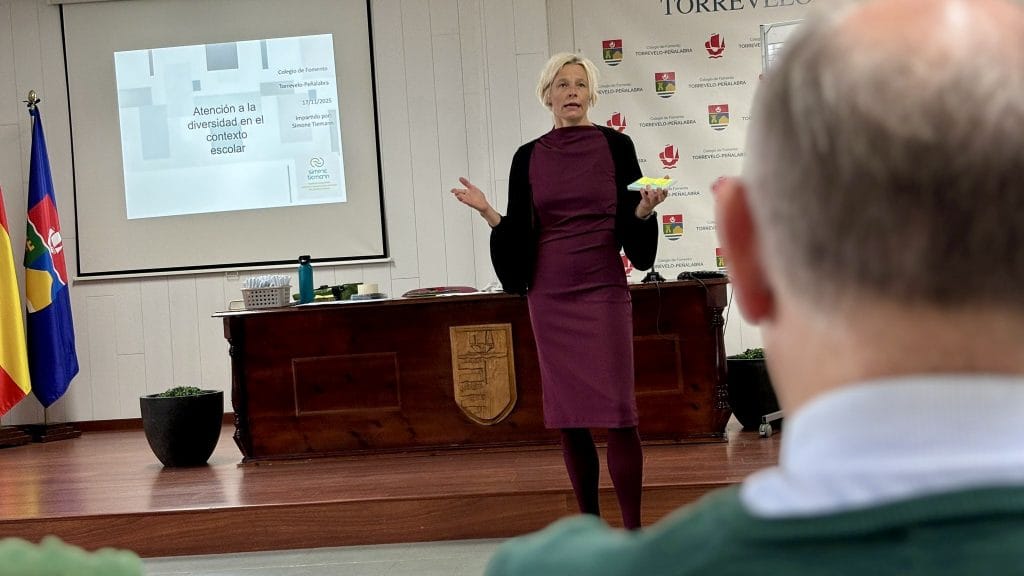
Throughout the training, we explored the importance of the teacher’s role in students’ learning. Through personal reflection activities, we examined the factors that support the teacher–student relationship and ultimately foster students’ motivation to learn.
One of the metaphors we used, attributed to Alexander den Heijer, was: “When a flower doesn’t bloom, you fix the environment in which it grows, not the flower.” This image helped us reflect on the aspects of the educational context that we can influence, while recognizing that our aim is not to “change” the student.
Working from foundational concepts—our perspective, self-reflection on personal values, attitude, and awareness of our own subjectivity—is an essential starting point for genuinely approaching diversity in the classroom. We are all different, and it is up to us to find ways to understand and respond to the needs of each student. This requires a strengths-based perspective, mental flexibility to embrace heterogeneity, attention to relationships, acceptance, and trust.
It was a pleasure to work with the teaching team, to reflect together, and to develop new ways of seeing that lead to meaningful change.